Pesticide Study: Use of Dangerous Agents Has Increased Significantly
The use of more problematic plant protection products in Austria has increased in recent years. This was revealed in the response to a parliamentary inquiry by the Green Party's agriculture spokesperson, Olga Voglauer. The areas potentially treated with substitution candidates have more than doubled from 2010 to 2024, and those with PFAS pesticides have almost tripled, as shown by the sales volumes published by the Ministry of Agriculture.
Increase in the Use of High-Risk Pesticides
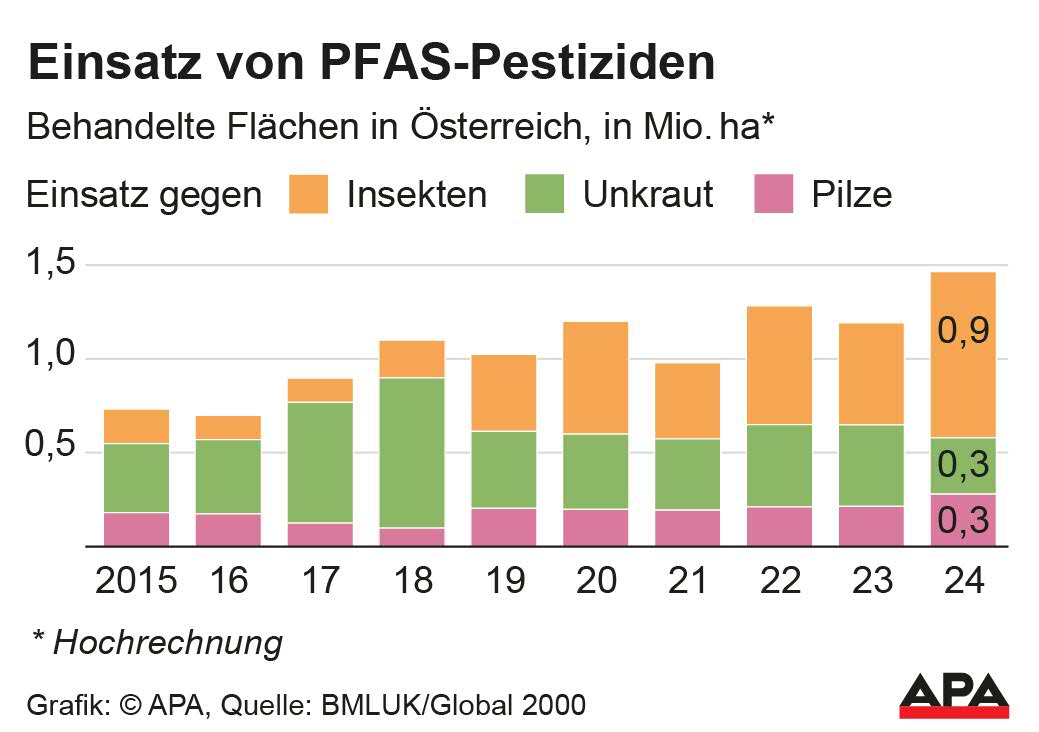
With the active ingredient-specific data published in response to the inquiry, Global 2000, on behalf of the Greens, calculated how many hectares can be treated with the sold substances. "For the first time, we now know the true state of pesticide use in Austria, and the results are dramatic," Voglauer stated. The potentially pesticide-treated area calculated has increased by 22 percent from 2010 to 2024 and currently amounts to 7.5 million hectares. However, the calculated area with substitution candidate active ingredients increased by about 106 percent from 1.35 million to 2.78 million hectares in the same period, and those with PFAS active ingredients increased by over 175 percent, tripling from 0.53 million to 1.46 million hectares.
Voglauer Criticizes Inaction
According to Voglauer, the massive increase in the use of particularly dangerous pesticides is especially problematic for those working in agriculture, "because they have the greatest risk of health impacts from handling the substances." She criticized Agriculture Minister Norbert Totschnig (ÖVP), as he has been aware of these figures for years, "and he has done nothing to restrict the use of particularly dangerous active ingredients. This is highly negligent."
Environmental physician Hans-Peter Hutter also criticized the use of plant protection products in a statement, as it is "no longer a surprise that most fungicides and insecticides are neurotoxic," which, among other things, increases the risk of Parkinson's. The data situation for individual substances varies, but according to a recent literature review, no active ingredient can be considered harmless in this regard.
NGO Demands Implementation of EU Guidelines
Global 2000 explicitly welcomed in a statement that the Ministry of Agriculture has now made the complete data publicly accessible for the first time with the current response. However, the NGO criticized that the figures show that, for example, substitution candidates are among the most frequently used active substances. This is a lack of implementation of a legal mandate from the EU. According to the EU, pesticides are considered substitution candidates if they contain active substances that are classified as reproductive toxic (endangering reproduction) or mutagenic (altering genetic material). These higher-risk plant protection products should actually be replaced by less dangerous alternatives by the member states.
The problem with substances referred to as PFAS pesticides is that their degradation product trifluoroacetic acid or trifluoroacetate (TFA) is suspected of being reproductive toxic and, as a "forever chemical," also exhibits the properties of being "hard to degrade and long-lasting." Denmark was the first EU state to issue national bans for 23 of these pesticides in July 2025.
Global 2000 Explains Calculation
After several objections to the calculations by Global 2000, including the Ministry of Agriculture referring to an increase in pesticides for organic production in the Ö1 "Morgenjournal," the NGO responded to this criticism in a release. "In fact, in Austria, only about 370,000 hectares of the pesticide-treated area are treated with active substances that are permitted in organic farming. This corresponds to only five percent of the 7.5 million hectares that are treated with pesticides in total," explains Helmut Burtscher-Schaden, environmental chemist at Global 2000.
Additionally, the NGO pointed out that the calculations were carried out using the standard hectare application rates published by the German Federal Environment Agency. This converted the amounts of active substances into those areas that can actually be treated with a specific active substance. According to Burtscher-Schaden, this is the "decisive measurement for pesticide use." Here, Minister of Agriculture Norbert Totschnig (ÖVP) responded in a release by pointing out that it is essential "that the amount of an applied active substance does not indicate its danger. For a professional assessment, the risk is decisive, not the pure weight."
Carbon Dioxide Not Included
In contrast, Ferdinand Lembacher, Secretary General of the Chamber of Agriculture, commented in the Ö1 "Mittagsjournal" on the "alleged increase in pesticides," stating that this could only result from including CO2, which is used for the preservation of fruit. However, the use of carbon dioxide was deliberately not included in the evaluation by Global 2000, as this "inert gas" is not applied to agricultural land but is mainly used after harvest to protect storage stocks from pests.
(APA/Red)
This article has been automatically translated, read the original article here.
Du hast einen Hinweis für uns? Oder einen Insider-Tipp, was bei dir in der Gegend gerade passiert? Dann melde dich bei uns, damit wir darüber berichten können.
Wir gehen allen Hinweisen nach, die wir erhalten. Und damit wir schon einen Vorgeschmack und einen guten Überblick bekommen, freuen wir uns über Fotos, Videos oder Texte. Einfach das Formular unten ausfüllen und schon landet dein Tipp bei uns in der Redaktion.
Alternativ kannst du uns direkt über WhatsApp kontaktieren: Zum WhatsApp Chat
Herzlichen Dank für deine Zusendung.