Study: Fewer and Fewer Austrians Trust Politics
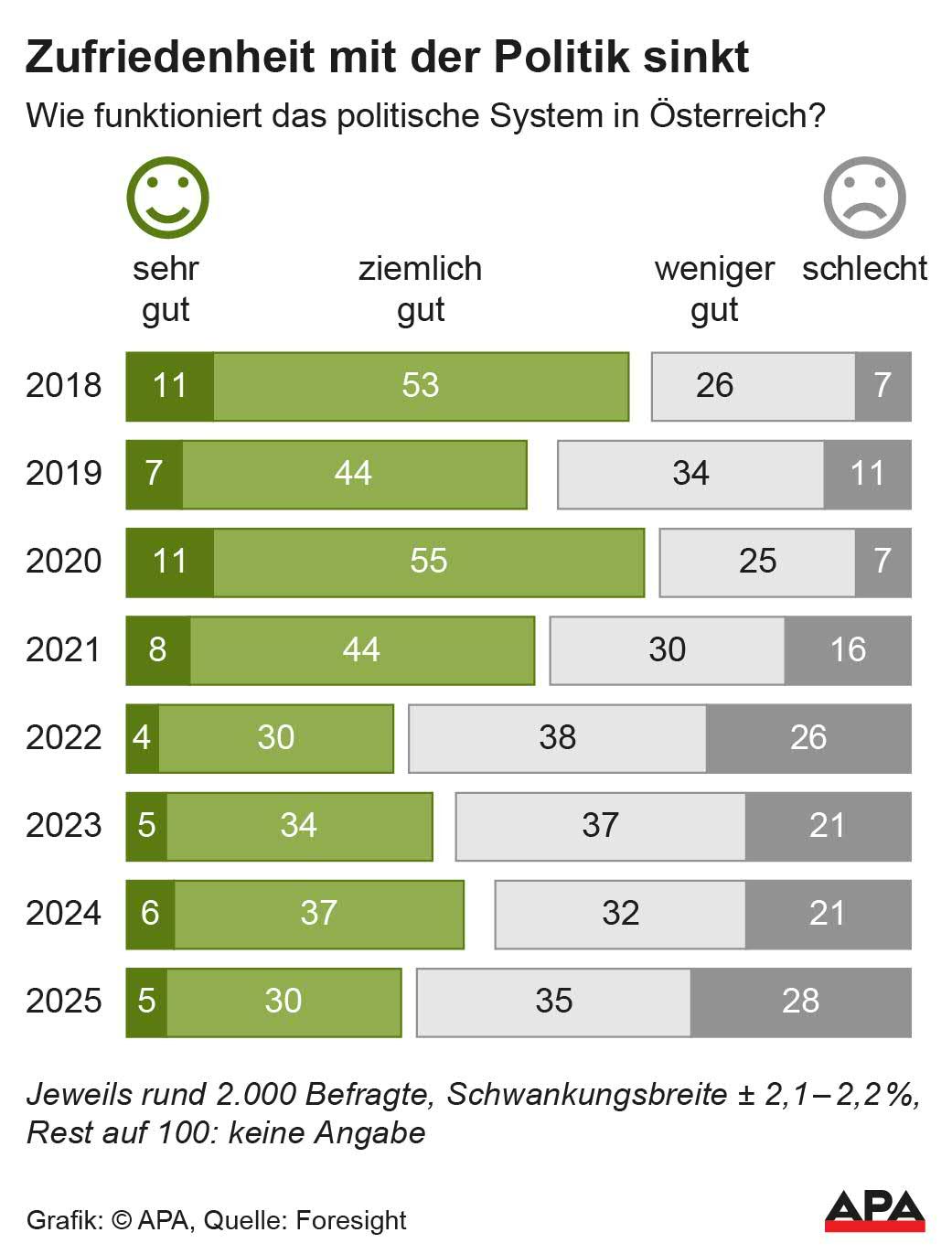
Only 35 percent of the population believe that the political system in Austria is functioning well. The declining values are mainly due to inflation and the experience that their own interests are not being represented, explained Martina Zandonella. She presented the results of the Democracy Monitor from the Foresight Institute on Wednesday. However, the attitude towards democracy remained the same: 89 percent consider it the best form of government.
In October and November, 2,005 people living in Austria aged 16 and over were surveyed (margin of error 2.2 percent). In 2018, when the annual project was first conducted, approval was almost twice as high: 64 percent then said that the political system in Austria was working very well or quite well. In 2024, it was at least 43 percent.
Satisfaction with Political System Has Dropped Significantly
Zandonella sees a crisis of representation. The negative development affects elected institutions and individuals. 48 percent trust the Federal President (2018: 58 percent), 41 percent the Parliament (2018: 48 percent), and 32 percent the Federal Government (2018: 43 percent). This development is noticeable in most Western democracies, said the researcher. Better trust values in this country are held by the police (73 percent), the courts (64 percent), and the administration (60 percent) - these numbers have hardly changed since 2018.
Satisfaction with the political system has decreased in all population groups. The financial situation is particularly relevant for this: only 19 percent in the lowest income third think that the system is functioning well (2018: 49 percent). In the middle income third, 38 percent believe this (2018: 66 percent), and in the highest income third, 50 percent (2018: 85 percent).
People with lower incomes have particularly rarely had experiences that correspond to the ideal of democracy - for example, that every vote counts equally, according to Zandonella. Only 17 percent in the lowest third believe that people like them are well represented in Parliament, while in the highest third it is 45 percent. They are also more affected by inflation - 79 percent in the lowest third stated that they had to save on grocery shopping. Across all respondents, it was 47 percent.
Inflation as the Most Important Concern
Inflation is also the top issue for the population: 35 percent named it as their most important political concern at present, particularly the high costs of food, energy, and housing. For 23 percent, distribution issues such as poverty reduction and wealth security are the most important concerns. 18 percent mention immigration - ten percent expressed concern about it, for example due to integration, eight percent used derogatory terms and right-wing extremist terms like remigration, Zandonella explained. For another eight percent, the focus is on the economy and work, healthcare, and internal and external security, and for seven percent, the topic of climate and sustainability.
There are hardly any changes in the perception of democracy. 89 percent consider it the best form of government, while at the same time, 20 percent wish for a "strong leader." A similar picture was already evident in 2018. There is room for improvement in democratic awareness, but democracy is not losing approval, Zandonella concluded.
(APA/Red)
This article has been automatically translated, read the original article here.
Du hast einen Hinweis für uns? Oder einen Insider-Tipp, was bei dir in der Gegend gerade passiert? Dann melde dich bei uns, damit wir darüber berichten können.
Wir gehen allen Hinweisen nach, die wir erhalten. Und damit wir schon einen Vorgeschmack und einen guten Überblick bekommen, freuen wir uns über Fotos, Videos oder Texte. Einfach das Formular unten ausfüllen und schon landet dein Tipp bei uns in der Redaktion.
Alternativ kannst du uns direkt über WhatsApp kontaktieren: Zum WhatsApp Chat
Herzlichen Dank für deine Zusendung.


