Tourism Reached New Record High

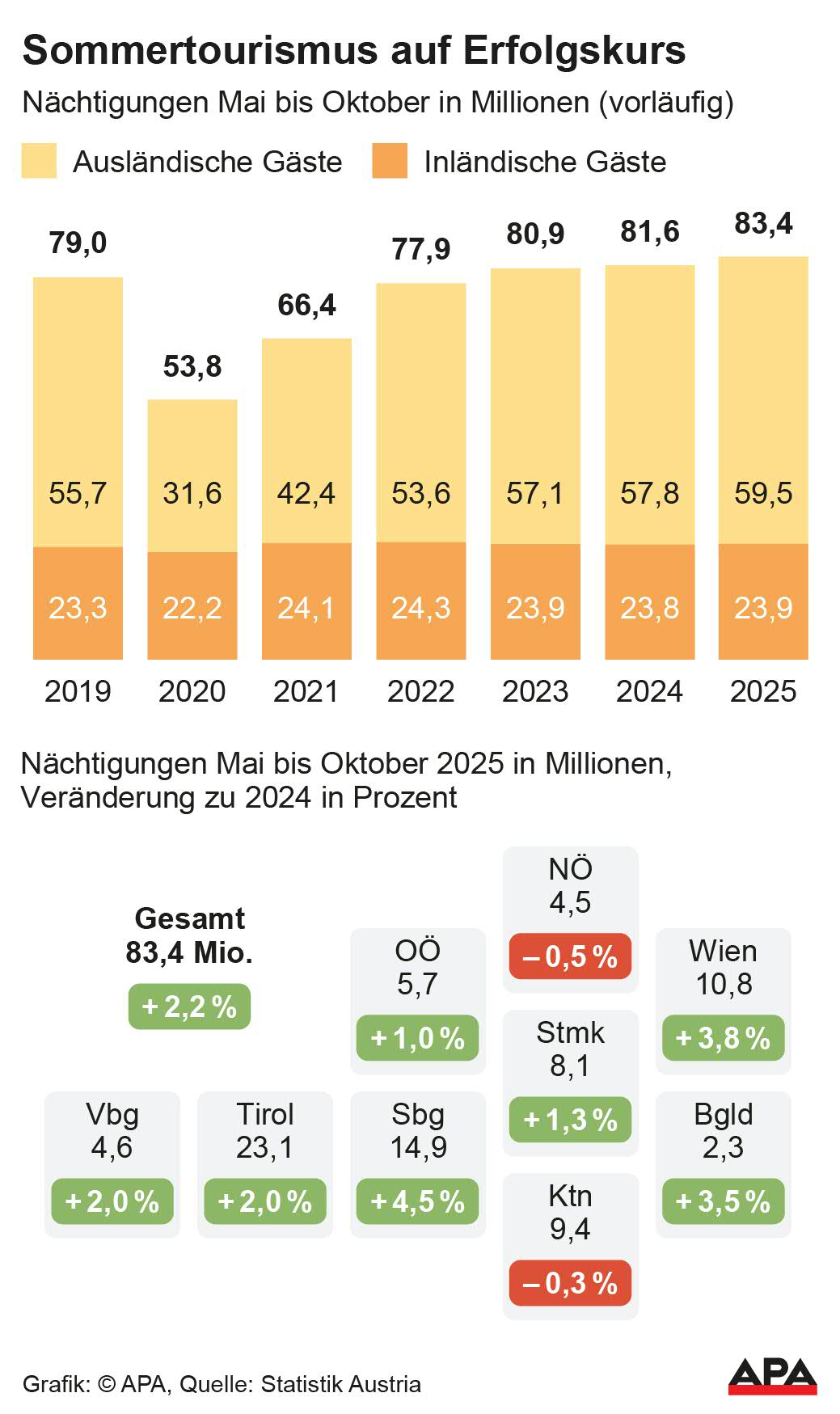
Holidays in Austria were more popular than ever this summer season (May to October). The well-booked off-season, especially in October, also contributed to this. During the reporting months, bookings in domestic hotels, guesthouses, and holiday apartments increased by an average of 2.2 percent to 83.4 million overnight stays, surpassing the previous peak from the previous year, as Statistics Austria announced on Friday based on preliminary data.
Main vs. Off-Season
According to the information, the number of overnight stays in the main and off-season is becoming increasingly similar. "In the mid-1970s, only about 35 percent of summer overnight stays were in May, June, September, and October; currently, half of the overnight stays occur in the months of the pre- and post-season," reported Statistics Austria Director General Manuela Lenk. In 2006, the share of the off-seasons exceeded the 50 percent mark for the first time, with a slight predominance of the post-season (September, October) over the pre-season (May, June) since then.
This October, overnight stays increased by 1.5 percent to 9.22 million - with an increase of 2.8 percent to 6.23 million from foreign tourists and a decrease of 1 percent to just under 3 million from domestic guests.
Germany at the Top
The majority of bookings for the entire summer season were from foreign guests, with 59.5 million overnight stays and an increase of 2.9 percent, especially from Germany with 32 million overnight stays (up 1.2 percent). Demand from domestic guests increased only marginally by 0.3 percent to 23.9 million overnight stays.
Bookings from the Netherlands slightly declined, decreasing by 0.2 percent to 4.2 million overnight stays year-on-year. There was also less demand from Switzerland and Liechtenstein, with a decrease of 1.8 percent to 2.43 million overnight stays. At the same time, there were increases in bookings from guests from the Czech Republic by 6.2 percent (1.9 million overnight stays), Italy by 1.4 percent (1.7 million), and the USA by 3.4 percent (1.5 million).
Vienna in Third Place
The most visited federal state by far was Tyrol with 23.1 million bookings (plus 2 percent). This was followed by Salzburg with 14.9 million overnight stays (plus 4.5 percent) and Vienna with 10.8 million (plus 3.8 percent), as well as Carinthia with 9.4 million (minus 0.3 percent) and Styria with 8.1 million (plus 1.3 percent). In the middle range were Upper Austria with 5.7 million overnight stays, Vorarlberg with 4.6 million (plus 2 percent), and Lower Austria with 4.5 million (minus 0.5 percent).
"Strong Signal for Tourism Location"
"This summer season is a strong signal for our tourism location," said Tourism State Secretary Elisabeth Zehetner (ÖVP) in a press release. However, "the challenges in the background" should not be overlooked, she emphasized, referring to high energy prices, rising costs, and noticeable bureaucracy. "Our goal as the federal government is clear: We want success on paper to also translate into success in the bank account." An important concern is the reduction of energy costs. "Electricity prices for businesses and households should noticeably decrease," Zehetner promised.
Economically, many businesses are under pressure despite good bookings, the Austrian Hotel Association (ÖHV) also noted in a statement. "The fact that overnight numbers are rising does not change the fact that businesses are economically challenged," said ÖHV Secretary General Markus Gratzer. The cost development is more dynamic than the revenue situation - "and that is not sustainable in the long run." At the same time, access to financing is becoming more difficult, which complicates necessary investments in modernization, energy efficiency, and quality. Price increases can only be partially enforced in the market, creating "additional pressure on the economic substance."
"No Measure for Economic Success"
"Full beds alone do not guarantee economic success," the Hotel Industry Association in the Austrian Chamber of Commerce (WKÖ) also emphasized in a release. "We must finally stop pretending that full beds automatically mean full cash registers," said Association Chairman Georg Imlauer, referring to the high personnel and energy costs. The economic reality of the hotel industry is unpleasant but simple: Costs are at a very high level, while price enforcement is becoming increasingly difficult, and guests are saving on additional services and consumption. As a result, revenues are stagnating. "Overnight numbers are a mood barometer, but not a measure of economic success."
(APA/Red)
This article has been automatically translated, read the original article here.
Du hast einen Hinweis für uns? Oder einen Insider-Tipp, was bei dir in der Gegend gerade passiert? Dann melde dich bei uns, damit wir darüber berichten können.
Wir gehen allen Hinweisen nach, die wir erhalten. Und damit wir schon einen Vorgeschmack und einen guten Überblick bekommen, freuen wir uns über Fotos, Videos oder Texte. Einfach das Formular unten ausfüllen und schon landet dein Tipp bei uns in der Redaktion.
Alternativ kannst du uns direkt über WhatsApp kontaktieren: Zum WhatsApp Chat
Herzlichen Dank für deine Zusendung.


